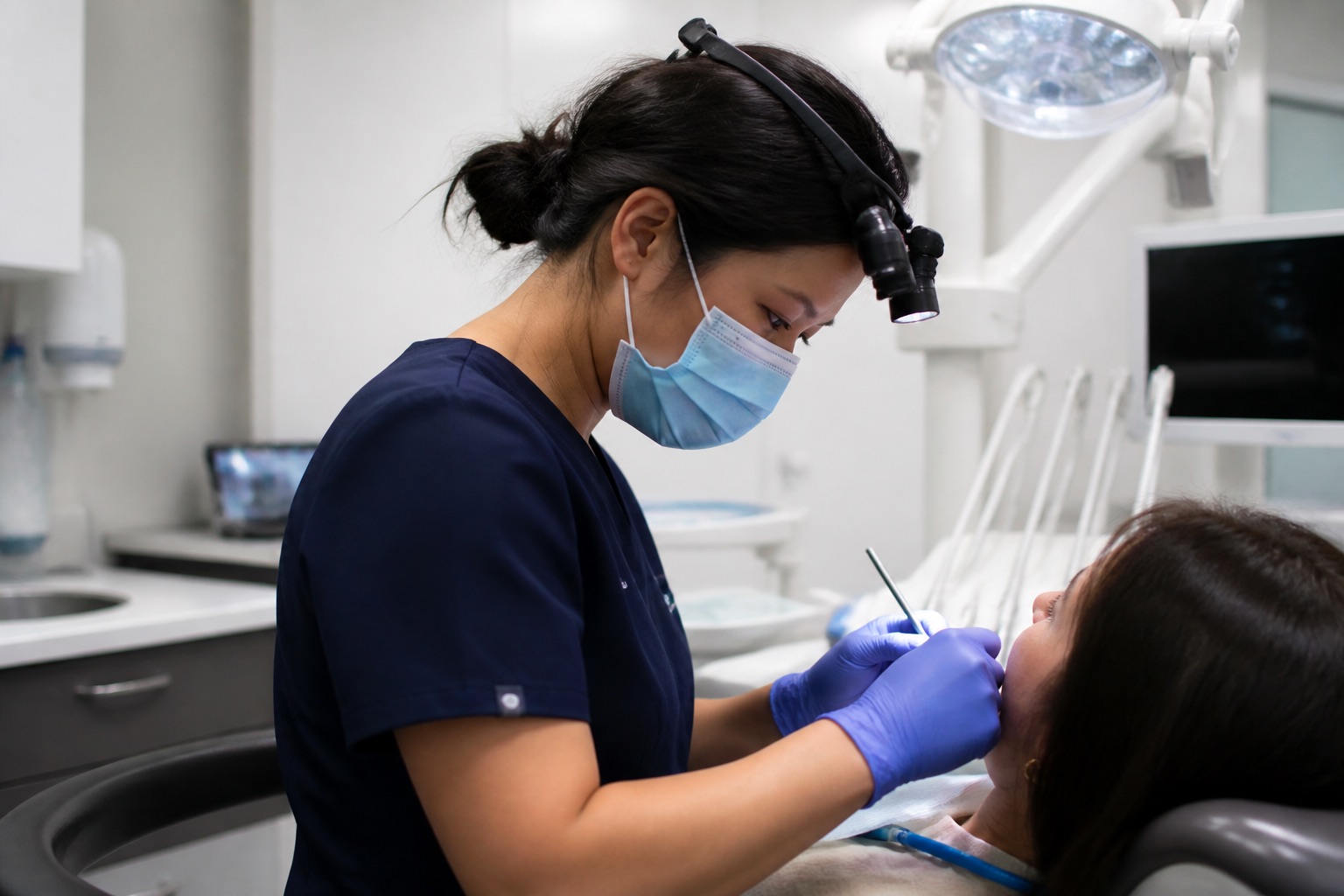
If you come to us wanting a crown and your gums are bleeding, we will treat the gums first. Not as a policy, and not to add appointments — because a crown margin built against inflamed tissue is being built against something that is going to move, on a surface we cannot keep dry, in a mouth where the reason the tooth failed has not been dealt with.
It is the least glamorous thing about how we work and it is the thing that most changes how long the work lasts. It is also the part almost nobody explains, so people experience it as a delay. Here is the actual reasoning.
Reason one: you cannot bond to a wet field, and inflamed gums are wet
Modern composite fillings are adhesive. They are not wedged into a hole; they are chemically and micromechanically bonded to the tooth. That bond forms in a specific sequence of etching, priming and curing, and every step of it is destroyed by moisture.
Healthy gum tissue is fairly quiet. Inflamed gum tissue is not: it bleeds when touched and it weeps gingival crevicular fluid, a serum-like fluid that seeps out of the inflamed sulcus continuously and increases in volume the more inflamed the site is. If your margin sits at or below the gum line, which is exactly where the margins that matter most sit, you are trying to establish an adhesive bond in a slow leak.
Blood or crevicular fluid contaminating the bonding surface at the wrong moment reduces bond strength substantially. What you get is a margin that is not sealed. What that produces, months to years later, is microleakage: bacteria track down the interface between filling and tooth, and you get recurrent decay under a restoration that looks perfectly fine from the outside. Then it gets redone, bigger. Then eventually it needs a crown.
This is why we use rubber dam for restorative work — it isolates the tooth from saliva, tongue, cheek and breath, and holds the field dry. It is also why we use air abrasion to prepare bonding surfaces, which produces a cleaner, more retentive surface for the adhesive. Both of those are pointless if the gum next to the tooth is pumping fluid into the field. The dam controls saliva; it does not control an inflamed sulcus. Only treating the inflammation does that.
Dr Melissa Huang’s summary of how we work is blunter than any of the above: every step of the procedure to the highest standard, no shortcuts — rubber dam, air abrasion, proper moisture control, and manage the periodontal condition first so the gums are not bleeding during restorative procedures.
Reason two: the gum margin you build to today is not where it will be
This one is specific to crowns, veneers and anything else with a defined finish line, and it is the one patients find most persuasive once they hear it.
Inflamed gum is swollen. Swelling means the gum margin is sitting higher up the tooth than it will once the inflammation resolves. So if we prepare a tooth, take a scan and have a crown made while the tissue is swollen, we are recording a margin position that is temporary.
Two weeks later, the inflammation settles, the tissue shrinks back to where it actually belongs, and the crown margin that was neatly at the gum line is now sitting visibly above it — a dark line at the neck of a front tooth, or an exposed margin at the back that becomes a plaque trap and a decay site. The crown was made correctly. It was made to the wrong tooth.
The scanning problem compounds it. We use a Medit intraoral scanner rather than a tray of impression material for most work, and a scanner is an optical device: it records what it can see. A margin buried under bleeding, swollen tissue cannot be seen, so it cannot be captured accurately, and the laboratory then has to guess at a finish line. A crown seated on a guessed margin either has an overhang or a gap, and both of those cause exactly the gum problem you came in with, permanently, in a place you cannot clean.
So: settle the tissue, let it find its true position, then prepare and scan. The crown fits the tooth you actually have.
Reason three: perio changes whether the restoration is a good idea at all
This is the one that saves people the most money, and it is the reason we chart before we plan.
A crown is a significant investment — the Australian Dental Association’s 2022 national fee survey, reported by CHOICE, put the average fee for a full veneered crown (item 615) at $1,678, with a range of roughly $1,250 to $2,100. It is a poor investment on a tooth with seven-millimetre pockets, advanced bone loss and mobility, because the crown will outlast the tooth’s foundation.
You cannot see that from the outside. The tooth can look fine and feel fine. The way you find out is by measuring — periodontal charting, ADA item 221, recording pocket depths at six sites per tooth, bleeding on probing, recession and mobility, checked against bitewings (item 121) and an OPG (item 037) that show the bone level directly.
Sometimes the charting changes the plan entirely: the sensible answer is periodontal treatment and monitoring, and a decision about that tooth in a year, rather than crowning it now. Sometimes it changes the design: a different span for a bridge, or a removable option, because the abutment teeth will not carry it. Occasionally it means the tooth should come out, and we would much rather know that before you have paid for a crown on it than after.
The same logic runs the other way for dental implants: an implant is placed into bone and surrounded by gum, and untreated periodontal disease is the single most predictable way to compromise one. We assess and plan implants, refer the surgery, and restore them here — and the gums come first there too.
Reason four: the cause is usually still running
If a filling failed at the margin, or a tooth broke, something produced that. Most of the time it is one of a short list: biofilm sitting undisturbed at a site your routine misses, an overhanging margin on an old restoration acting as a plaque trap, a dry mouth from a medication, grinding, or periodontal disease itself.
Restoring the damage without addressing the cause means restoring it again. Dr Melissa Huang’s stated reason for building the practice the way she has is finding the root of the problem, and fixing what needs intervention properly the first time — with the goal of not having to redo it for at least a decade. You cannot get near that if the mechanism that broke the tooth is untouched.
What this looks like on your calendar
Why this is sequencing rather than stalling:
- First visit — a full hour. Ten to thirty minutes of conversation before any instrument comes out: what you want, what you want to avoid, past experiences. Then the examination — every tooth, the gums and periodontal pockets, oral cancer screening, jaws and jaw joints, plus radiographs, usually bitewings and an OPG. Then findings and options, in plain language.
- Periodontal phase, if it is needed. Cleaning above and below the gum line — using Airflow / Guided Biofilm Therapy where there is significant biofilm, which is more comfortable on inflamed tissue than heavy hand scaling, plus the specific home-care changes for the sites your routine is missing. For gingivitis this is often a couple of weeks. For established periodontitis it is a course of treatment across quadrants.
- Re-chart. We measure the same sites again. Bleeding down, pockets settled, tissue at its true position. This is the gate, and it is a numeric one.
- Then the restorative work. Rubber dam, air abrasion, a dry field, a margin you can actually see, and a scan the laboratory can build to.
If you are in pain, none of this applies — we deal with the pain first, same day where we can. Sequencing is for planned work, not for emergencies.
Where you will notice the difference
Mostly in what does not happen: margins that stay sealed, crowns that seat properly, gums that are not permanently irritated by the edge of a restoration. Dr Melissa Huang’s clinical interests are prosthodontics and complex bite problems, which is precisely the work where a compromised foundation shows up soonest, and Dr Annie Tong and Dr Linda Huang carry a lot of the periodontal side of this in the practice.
If you want the underlying detail, start with gum disease treatment, or read why home care alone is enough for some people and not others. If a crown is what brought you here, our crowns and bridges and tooth-coloured fillings pages set out what the work itself involves.
Whitehorse Dental is at 129A Canterbury Road, Blackburn VIC 3130, with on-site parking and Saturday morning appointments. Consultations are available in Mandarin, Cantonese, Teochew, Shanghainese and English. Call (03) 8838 8820 or book online.