The honest answer is: it depends which stage you are at, and the two stages are not close to each other.
Gingivitis is genuinely reversible. The inflammation sits in the gum tissue only, nothing has been permanently lost, and if the cause is removed the tissue goes back to normal. Not “improves”. Back to normal.
Established periodontitis is not reversible. It is manageable. Once the disease has destroyed the bone and the fibres that attach the tooth to that bone, those do not grow back on their own. What we can do, and do routinely, is stop the destruction, settle the inflammation, and hold the position you are at now for decades.
That distinction is the whole thing. It decides what your treatment looks like, what a good outcome even means for you, and how often you need to come back. So most of a first gum appointment at Whitehorse Dental is spent working out which side of that line you are on, before anyone talks about treatment.
What “reversible” actually means
It helps to be precise about what is being lost.
A healthy tooth sits in bone, and is tied to that bone by periodontal ligament fibres that insert into the root surface. The gum forms a shallow cuff around the tooth — a sulcus, normally about 1 to 3 millimetres deep, which we can measure with a graduated probe.
In gingivitis, plaque bacteria at the gum margin cause the gum to become inflamed. It goes red, swells, and bleeds when disturbed. The cuff can measure a bit deeper because the swollen tissue sits higher, not because anything underneath has been lost. Remove the plaque and calculus, keep it off, and the swelling resolves. Nothing to reverse, because nothing was destroyed.
In periodontitis, the inflammation has gone below that cuff. The attachment fibres detach from the root, the bone supporting the tooth resorbs, and the sulcus becomes a true pocket: 4, 5, 7 millimetres deep, sometimes more. Now bacteria are living in a space you cannot reach with a toothbrush, on a root surface that is no longer covered by gum. That lost bone and lost attachment is the part that does not come back.
You can see why “can it be reversed” gets answered so vaguely online. The two conditions share a name and share a symptom (bleeding), and are almost completely different problems.
How we work out which one you have
You cannot tell from the mirror, and neither can we from looking. It is measured.
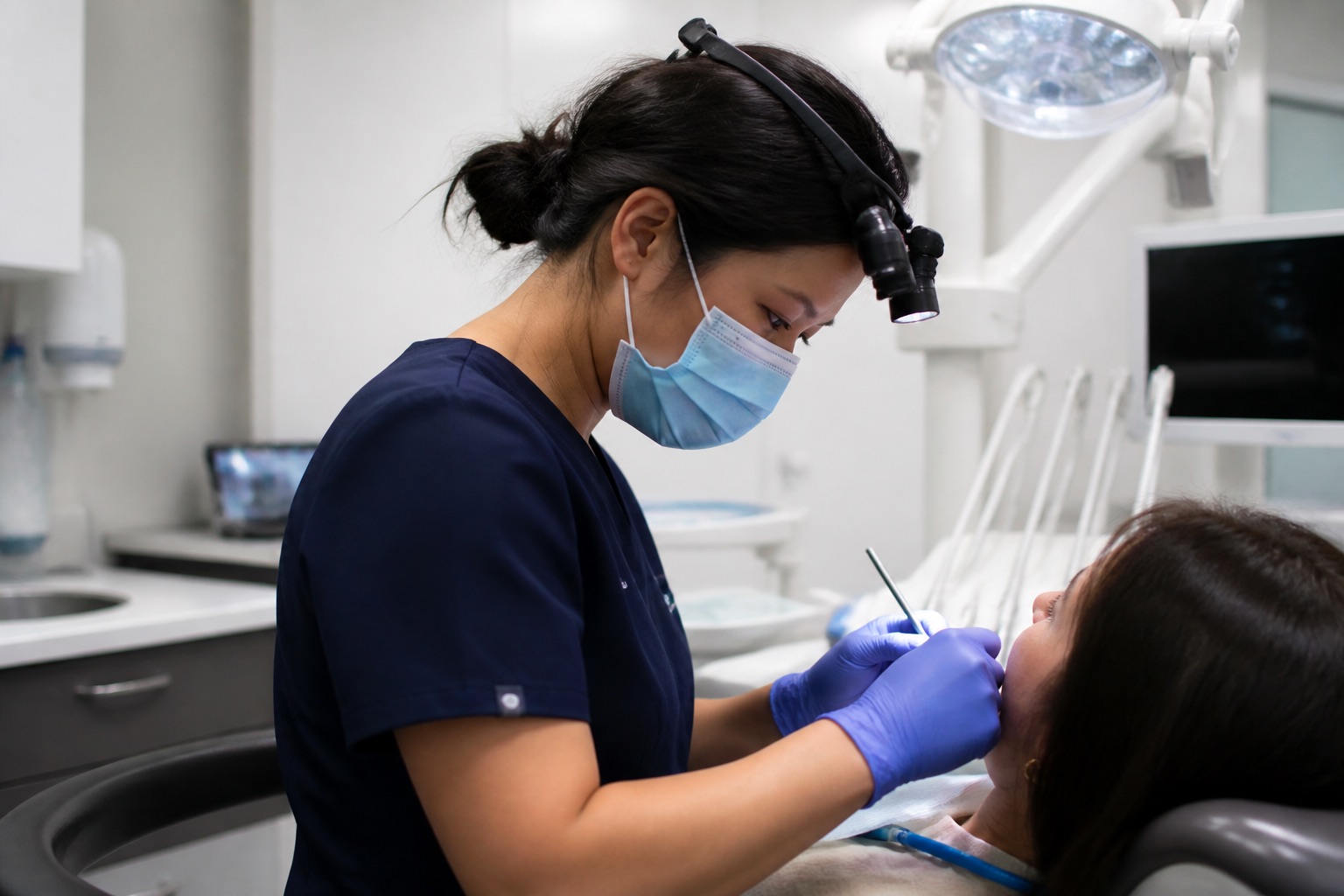
At a comprehensive examination (ADA item 011) we check every tooth, the gums, the jaw joints, and screen for oral cancer. Where the gums warrant it, we do a full clinical periodontal analysis and recording — ADA item 221, which is the formal name for gum charting. In practice that means walking a probe around each tooth and recording, site by site:
- Pocket depth at six points around every tooth
- Bleeding on probing: which sites bleed when gently provoked, and which do not
- Recession: where the gum margin sits relative to where it should
- Mobility and furcation involvement: whether the tooth moves, and whether the disease has reached the split between the roots of a molar
Then we compare that against the radiographs. Bitewings (item 121) show the bone level between the teeth clearly, and an OPG (item 037) gives us the whole picture at once. Bone loss is visible on a film in a way it never is in the mouth.
What comes out the other end is a number set, not an impression. Bleeding on 40% of sites with every pocket at 3mm and no bone loss on the films is gingivitis, and it is fixable. Six-millimetre pockets on the upper molars with visible bone loss is periodontitis, and the conversation is different.
The reason we chart rather than eyeball is that at your review, we do it again. If your bleeding score has gone from 40% to 8%, the treatment worked and we both know it. That is not a judgement call.
Reversing gingivitis: what it actually takes
Two things, in this order.
Remove what is already there. Plaque you can shift at home. Calculus, the hardened tartar, you cannot, because it is bonded to the tooth, and because its rough surface is a permanent plaque trap. That comes off professionally (item 114). Where there is a lot of biofilm, we use Airflow / Guided Biofilm Therapy: the biofilm is disclosed with a dye first so it is visible, removed with a fine erythritol powder spray, and only then do we instrument the actual hard deposits. It means less scraping of surfaces that did not need it, and it is noticeably more comfortable, which matters if you have been putting this off for years.
Stop it coming straight back. This is the half that decides the outcome, and it is the half that gets least attention. Plaque re-forms within hours. If the same sites are missed every day, the same sites will be inflamed again in a fortnight.
Given both of those, gingivitis usually settles within two to three weeks. We book a review specifically to re-check the bleeding sites, because “it feels better” is not the same as “it stopped bleeding”.
Managing periodontitis: what stable looks like
If the charting shows bone loss, the goal changes from cure to control, and control is a genuinely good outcome. People keep teeth for thirty years on stabilised periodontitis.
Treatment is mostly non-surgical. We clean the root surfaces below the gum line so the inflamed tissue has a clean surface to reattach against, quadrant by quadrant, over a course of appointments rather than one heroic session. Pockets shrink partly because the inflammation resolves and partly because the tissue tightens back down. Then we re-chart, and we set a maintenance interval from your numbers. For many periodontitis patients that is three or four months, not six, because the bacterial population in a deep pocket rebuilds faster than a brush can control.
Two things we tell people plainly:
The bone does not come back. Claims otherwise deserve suspicion. Some sites with specific bony defects can be treated surgically by a periodontist with regenerative techniques, but that is a narrow indication, not a general promise.
We do not perform periodontal surgery here. Where a case needs surgical periodontics (flap surgery, regeneration, a graft for advanced recession), Dr Melissa Huang assesses it, explains the options, and refers you to a periodontist. Your ongoing periodontal care then continues with us, because a surgically treated site still needs the same maintenance every other site needs, and it needs it from someone holding your full record.
Who you will see
Dr Melissa Huang’s interests are prosthodontics and complex bite problems, and periodontal disease sits underneath both of those, because you cannot build durable restorative work on gums that are still active. Dr Annie Tong and Dr Linda Huang both do a lot of periodontal care here as well. If the part you are dreading is having your gums probed, say so when you book — Dr Tong sees many of our more anxious patients, and there are ways to make the charting appointment easier. Consultations are available in Mandarin, Cantonese, Teochew, Shanghainese and English throughout treatment, which matters when the plan runs over several appointments and involves numbers you are being asked to act on.
Why it is worth doing something about
Periodontal disease is the main reason adults lose teeth, and it does it quietly. It is not usually painful until it is advanced, which is exactly why people arrive surprised. It also does not stay in your mouth. The Victorian Government’s Better Health Channel notes that if gum disease is not kept under control it can have negative effects on heart health and can worsen diabetes. That is an association rather than a simple cause and effect, and we have written about what the evidence does and does not support — including why an Australian preventive-health company, Everlab, refers patients to us when their testing flags inflammation.
Blackburn skews older than the Melbourne average, with a median age of 41 at the 2021 Census and 18.4% of residents aged 65 or over, and the years where periodontitis quietly costs people teeth are exactly those years. Catching it at the gingivitis stage is not a slogan; it is the difference between a fortnight of better cleaning and a lifetime of three-monthly maintenance.
Where to start
If your gums bleed, we have written about what that actually means and it is worth reading before you decide it is normal. If you have been told you have “a bit of tartar”, here is why you cannot brush it off. And if you already know your home care is good and you are wondering whether that is enough, that question has a real answer too.
Otherwise, book a proper look. Gum disease treatment at Whitehorse Dental starts with charting, not with an opinion. We are at 129A Canterbury Road, Blackburn VIC 3130, with on-site parking and Saturday morning appointments. Call (03) 8838 8820 or book online.